Tradeclear – Unprecedented Times, Unprecedented Solution

On the 15th of June 2022, the Deputy Governor of the Bank of Uganda (BOU) officially launched Tradeclear or Umbrella Guarantee Facility in Kampala, Uganda. Uganda is the first country to put in place this Frontclear-designed and structured practical framework within which to develop a more stable and inclusive interbank market among local banks. Tradeclear deepens the interbank market by mitigating credit risk on interbank transactions, introducing best practice GMRA and ISDA documentation, reforming the legal and regulatory framework, and building knowledge and capacity among market participants.

In Uganda, the legal and regulatory review on enforceability of the GMRA and ISDA is in final stages and should be completed soon and a number of banks are now ready to sign up to the Umbrella Guarantee Facility also known as Tradeclear. Today marks the beginning of a formal relationship that we believe should contribute to further transformation of the financial markets landscape in Uganda.

Michael Atingi-Ego, Deputy Governor of the Bank of Uganda

Unprecedented Times

The COVID-19 pandemic and resulting economic crisis pushed governments the world over to increase public debt to unprecedented levels. While this ensured that deeper negative economic consequences were staved off, many developing countries are now left in a precarious position. The fiscal positions of EMDC governments have deteriorated after providing extensive support for two years. The increased local liquidity has masked real risk levels and inadequately reflected in lower credit spreads for countries and counterparties. Banks in EMDC markets have shown caution in terms of extending new loans to the private sector. Rather, financial institutions have shored up their portfolios in government securities, thereby helping local governments to deal with higher deficits (from fiscal support initiatives) and lower collected revenues (from reduced economic activity). The impact of the pandemic on banks’ asset quality will only be known once loan restructuring and debt service grace periods end, when clients are expected to fully perform on their obligations again.


As the pandemic’s impact on different sectors abates and the reduction in economic activity is reversing quickly, the massive liquidity and cost-push impacts of substantial reallocations of labor during COVID-19 are likely to lead to higher inflation. Frontier market central banks must be confident of their monetary policy toolbox when targeting this surge in inflation. Yet most face stubbornly inefficient transmission mechanisms. The existence of perceived and real counterparty credit risk segments the market and all but halts interbank activity and the flow of liquidity among banks. In addition, the absence of a legal and regulatory regime that supports close-out netting is a constraint to market development as it exposes the market participants to undue credit and liquidity risks in repo and derivative transactions.

In these ever-changing market circumstances, local bank access to global capital markets, and deepening domestic capital markets, remains as urgent as ever. Continued market access to diversified sources of domestic and international funding is central to managing heavy debt burdens and ensuring optimal allocation of capital in the economy.

Market Segmentation in Frontier Markets

Under normal market conditions, let alone in a crisis, (perceived) counterparty credit risk quickly dislocates banking relationships. Without access to the interbank system and in particularly repo, banks hoard liquidity as a primary risk mitigator. Larger banks experience lower borrowing costs and often only trade with one another. Smaller players, who often play an outsized role in serving SMEs, are locked-out or have high borrowing costs despite overall liquidity in the market. The financial system’s overall financial soundness and role to effectively extend loans and financial products to the real economy, suffers.

Unprecedented Solution

Banks rely on interbank markets to deal with immediate liquidity concerns and to transmit changes in monetary policy. Interbank lending is where banks borrow and lend to each other using financial instruments such as repurchase agreements (repos) and hedge balance sheet risks through derivatives. Central banks rely on the same interbank market to transmit their monetary policy signals. The segmentation of the interbank market due to counterparty credit risk concerns impairs both these mechanisms. Tradeclear©, an Umbrella Guarantee Facility (UGF), is a systemic approach to reducing a counterparty credit risk for the participants that allows for an inclusive and liquid interbank market, solving the market segmentation and repair monetary policy transmission.

In a Tradeclear all interbank transactions among eligible banks in a country are guaranteed. This mitigates counterparty credit risk and allows liquidity to flow among tiers in the system, while simultaneously building-up operational experience with best practice documentation (GMRA and ISDA) and transaction knowledge (e.g. margining, collateral management). Tradeclear© reflects pre-CCP market infrastructure solution and a secure approach to a more inclusive interbank market.

In a Tradeclear, Frontclear guarantees the payment of early termination and unwind values upon default of a participating bank, mitigating counterparty credit risk and settlement risk. Key expected benefits for the market includes an increased number of trading lines for each participating bank and thus reduced interbank segmentation between the different bank tiers. This should lead to improved pricing, reduced reliance on central bank facilities, improved market resilience to shocks, improved secondary bond market liquidity, development of an interest rate benchmark and yield curve and improved monetary policy transmission. Participating banks receive ongoing capacity-building support through the Frontclear Academy and gain access to the Tradeclear guarantee platform which provides valuation and collateral management capabilities to banks who have not yet developed these systems internally.

UNECA / Frontclear Partnership

The United Nations Economic Commission for Africa (UNECA) and Stichting FTAP (Frontclear Technical Assistance Programme, a Foundation) have formed a partnership to support African countries to address the adverse effects of the pandemic on national debt and financial markets. The direct purpose is to strengthen their local financial institutions, financial system and investor base (both domestic and international), which will not only help governments mobilize more funding for economic recovery and building back better, but also help build financial resilience towards future shocks. One of the activities supported by the partnership is the Tradeclear© Feasibility Study. Central Banks from African markets such as the Bank of Zambia, have signed the request to work with the local market and the partnership, to develop a Tradeclear© structure customized to their market, idiosyncratic features. The Zambia effort was kicked-off in a Lusaka workshop in late May 2022. The Study will consider local demand dynamics, legal & regulatory framework, clearing and settlement system and market knowledge, with a proposed model by close 2022.

An Invitation

Deep and efficient domestic government debt markets help provide resilience to shocks in times of financial turbulence and convey multiple economic benefits. These markets mitigate currency pressures and are central to broader capital market development, facilitating appropriate pricing of risk, allowing participants in financial markets to better manage their portfolios. In turn, these factors help boost a country’s long-term economic growth potential and ability to weather external shocks.
A participatory and liquid interbank market is key to the development of local currency government debt markets. Frontclear, through programmes like Tradeclear, continually strives to support local governments and banking sector counterparties, to develop their interbank and money market. The International Capital Market Association (ICMA) is a long-standing partner in this effort, combining with Frontclear to review and reform legal and regulatory frameworks in frontier markets. We welcome all ICMA members to join in these efforts to the benefit of global market stability and resilient financial markets (Sustainable Development Goals 8 ad 17).

About Frontclear

Frontclear is an Amsterdam based development finance institution. Frontclear is funded by European development finance institutions, including the European Bank for Reconstruction and Development (EBRD), the Dutch development bank FMO, the Financial Sector Deepening Africa (FSDA), the French development bank Proparco, The Currency Exchange Fund (TCX), the UK’s Foreign, Commonwealth and Development Office (FCDO) and the German Ministry of Development Cooperation (BMZ). Frontclear’s guarantees are counter-guaranteed by KfW, a AAA-rated German development Bank. Frontclear’s development mandate is focused on catalyzing more stable and inclusive financial markets in emerging and frontier markets through the provision of financial guarantees to cover counterparty credit risk. Frontclear also offers technical assistance to develop the financial infrastructure, legal environment as well as the skills and capacity of the local market participants.


Banking On A Theory Of Change

Banking On A Theory Of Change

Cardano Development is not a typical debt or equity investor. Operating from the principle that finance is an essential agreement for inclusive, sustainable, and resilient economic growth, the Amsterdam-based company has created innovative financial business concepts in emerging markets, directly mobilizing more than $2.5 billion of financing and contributing to the building of local markets.

Read more

GuarantCo provides Société Générale Cameroun and Société Commerciale de Banque Cameroun with USD 38.4 million XAF equivalent guarantee to finance TollCam and support infrastructure development in Cameroon

GuarantCo provides guarantee to Société Générale Cameroun and Société Commerciale de Banque Cameroun with USD 38.4 million XAF equivalent guarantee to finance TollCam and support infrastructure development in Cameroon

GuarantCo, part of the Private Infrastructure Development Group (PIDG), has provided a USD 38.4 million (XAF equivalent) guarantee solution to Société Générale Cameroun (SG) and Société Commerciale de Banque Cameroun (SCB), a subsidiary of Attijariwafa Bank Group to finance TollCam, a project company established by Egis and Fayat. The financing comprises a 14-year combined liquidity extension and partial credit guarantee to support debt for the modernisation, operation and maintenance of 14 toll plazas across Cameroon.

The project is being developed by the sponsors under a 20-year PPP agreement with the Government of Cameroon (GoC). The combined guarantees will help SG and SCB provide XAF 32.5 billion (circa USD 52.5 million) of long-term debt arranged by Société Générale Côte d’Ivoire to support the toll development project.

This is the first financing agreement solely focussed on toll plaza infrastructure in Africa and is expected to be replicated across other toll sites on the continent. The project will lead to significantly higher toll revenue collection via more secure and efficient toll gates, collections, and payment systems but without increasing the toll price or changing traffic flows. The extra revenues will benefit the GoC’s Road Fund which will invest in further development of the road network in Cameroon. It is also the first road related PPP in Cameroon and may lead to further involvement of the private sector in the development of the road network in the country.

There are regulatory constraints in Cameroon that limit lending to a maximum tenor of seven years, which is insufficient for the long-term debt requirements of infrastructure projects. GuarantCo’s liquidity extension guarantee provides the required support for lenders to double the tenor of their facilities from seven to 14 years, thus enabling the viability of the TollCam project. GuarantCo is also offering a 75 percent partial credit guarantee during the last seven years of the project as an additional risk mitigant for the lenders.

The project contributes to Sustainable Development Goal (SDG) 17.1 – Strengthen domestic resource mobilisation to improve domestic capacity for tax and other revenue collection and SDG 9.1 – Develop quality, reliable, sustainable and resilient infrastructure, including regional infrastructure, to support economic development and human well-being.

Layth Al-Falaki, CEO GuarantCo, said: “We are delighted to have closed our third transaction in Cameroon and to support the Government to further their road development ambitions in the country. TollCam is a first of a kind infrastructure project with much potential to be replicated in other African countries. This is our second liquidity extension guarantee in Africa, after Kékéli Efficient Power in Togo, and we are hoping to implement similar solutions in other countries to help unlock much needed long-term infrastructure financing.”

Philippe Serain, President TollCam said: “TollCam is very proud to be fully involved into the automatic tolling of the main Cameroon roads with 14-year local currency funding which will be a great landmark for the whole African continent.”

FSD Africa Investments commits £8m to finance a new class of asset allocators in Africa

Tapping the Capabilities of Africa’s Emerging Class of Capital Managers to Address a Systemic Gap in Finance for Small and Growing Businesses.

Nairobi, 9 June 2022 – FSD Africa Investments (FSDAi), the investment arm of FSD Africa, has announced an £8 million investment to support a new class of investors who are financing Africa’s small businesses and consider gender equity a key driver of financial performance.

In partnership with the Collaborative for Frontier Finance (CFF), and the Facility Manager, a Joint Venture of Cardano Development and Total Impact Capital Europe, FSDAi will provide the critical anchor funding for a new special purpose vehicle, Nyala Venture.

Nyala Venture will bridge the funding gap left by other institutions, by targeting a new class of capital providers serving small and growing businesses, particularly those which are led by women or are applying a gender lens investment strategy in Nigeria, Ghana, Kenya, Senegal, South Africa, and Uganda.

Small and medium-sized enterprises (SMEs) are one of the key growth engines of emerging-market economies, absorbing up to 70% of the labour market and generating 40% of gross domestic product. However, access to finance is often cited as the single largest constraint to growth. The International Finance Corporation and others have long documented that emerging enterprises across Africa are starved for capital in the USD50,000 to USD500,000 range – the “missing middle”.

Women-led businesses, which account for at least a quarter of entrepreneurs on the continent, predominately fall into this “missing middle” category and, in particular, have been adversely impacted by this dearth of capital to grow their enterprises.

To date, the combination of risk, size, collateral, and governance makes small and growing businesses unattractive propositions for traditional financial institutions and local banks. Similarly, it has been a challenge for institutional capital, development finance institutions and multilateral development banks to finance these smaller businesses consistently and at scale.

Through its investment in Nyala Venture, FSDAi is providing highly catalytic capital to address this gap. The new facility will leverage the experience and skills of African capital providers, many of which are founded and led by women themselves, who deliberately prioritise financing these “missing middle” stage enterprises. These asset allocators are an emerging class of indigenous capital providers that look to meet the financing needs of Africa’s small and growing enterprises. These fund vehicles apply innovative approaches and alternative investment structures specifically befitting the local business environment.

Along with addressing the funding gap faced by small and growing businesses, especially women-owned, FSDAi’s investment in Nyala Venture will demonstrate through its early stage support the critical role that this investment class will play in driving capital markets in Africa. In addition to its investment, FSDAi is funding the development of the Frontier Capital Learning Lab, which will document and share the learnings of these local capital managers and their small business portfolios over the coming years.

Nyala Venture will be highly flexible with its investment funds to meet the innovative approaches of these local capital providers. Funds will be available in the form of debt or equity. The investment activities of Nyala Venture will be managed by two highly respected impact investing firms, Cardano Development and Total Impact Capital.

Building on the leading support of FSDAi, Nyala Venture intends to raise additional capital to create a USD50-75 million fund over the coming 18 months.

Commenting on the investment:

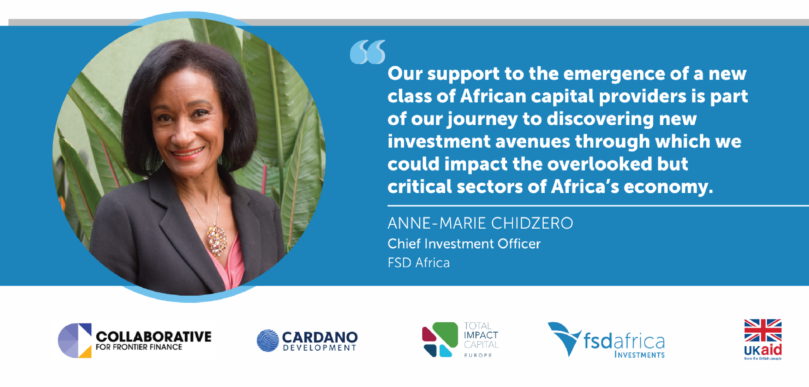
Anne-Marie Chidzero, Chief Investment Officer, FSD Africa Investments, said: “This new class of asset managers have better networks and embedded boots on the ground, enabling them to play a huge role in supporting and growing local businesses. Our support to them is part of our journey to discovering new investment avenues through which we could impact the overlooked but critical sectors of Africa’s economy and tap into the opportunity presented by women as investors and founders. “

Drew von Glahn, Executive Director, Collaborative for Frontier Finance, said: “The role that SMEs play in the creation of jobs and driving more resilient economies is well documented. Nyala, by working with these local capital managers, will not only provide the necessary capital to grow and sustain Africa’s emerging businesses, it will also demonstrate to the broader marketplace the critical role that women capital managers are playing in the continent’s finance innovation.”

Bart Schaap, Managing Director, Nyala Venture, said: “I believe the new investment facility will unlock opportunities in a new class of capital providers that has to date often been disregarded. By treading on uncharted paths, I am confident that we shall demonstrate the appropriateness of these Capital Providers for channeling funding to small and growing businesses in the African context.”

Jessica Espinosa Trujano, CEO of 2X Collaborative, said: “Nyala Venture will help drive and inform new investment vehicles targeting women-led small and growing business on the continent. With women-led businesses accounting for about a quarter of enterprises on the continent, we need better and more effective tools to overcome the funding gap they face.”

For more information, please contact:


Nelson Karanja
Director, Communications & Engagement
FSD Africa
[email protected]
About FSD Africa Investments

FSD Africa Investments (FSDAi) is the investing arm of FSD Africa, a specialist development agency working to reduce poverty by strengthening financial markets across sub-Saharan Africa. Based in Nairobi, FSD Africa’s team of financial sector experts work alongside governments, business leaders, regulators, and policymakers to design and build ambitious programmes that make financial markets work better for everyone. FSDAi invests in financial firms and intermediaries whose strategies could lead to transformative change in financial markets. Established in 2012, FSD Africa is incorporated as a non-profit company limited by guarantee in Kenya, and FSDAi as a Kenyan investment company. Both are funded by UK aid from the UK government. 

About Nyala Venture

Nyala Venture is a catalytic financing and support facility. With a priority for Gender Lens Investing, Nyala aims to contribute to strengthening economies by providing capital and capacity building services to Local Capital Providers (LCPs), which are best equipped to strengthen Small and Growing Businesses (SGBs), the most important business segment in any economy.

About Cardano Development

Cardano Development (CD) is an incubator and fund manager, established in 2007. Through careful risk-management analysis in data-poor settings, CD identifies scalable solutions that help to make frontier financial markets more inclusive, investible, and sustainable to unlock lasting economic value. CD creates solutions for local currency, credit, and liquidity risks in these markets. With over USD 6 billion assets and USD 1.5 billion capital under management, CD supports its scale-up funds and a number of start-ups with ongoing management services, financial support and corporate governance oversight.  Cardano Development works with reputable partners including foundations, governments, impact investors, institutional investors and commercial partners.