Cardano Development is not a typical debt or equity investor. Operating from the principle that finance is an essential agreement for inclusive, sustainable, and resilient economic growth, the Amsterdam-based company has created innovative financial business concepts in emerging markets, directly mobilizing more than $2.5 billion of financing and contributing to the building of local markets.
Cardano Development is a part of the World Economic Forum’sNew Champions community. A group of mid-sized companies championing new models, emerging technologies and sustainable growth strategies. Our CEO, Joost Zuidberg and eight other members shared their thoughts on what it takes for companies to be ‘future ready’.
The Impact Investorhas published an article covering how Cardano Development is joining forces with a team of housing experts to create a platform to build affordable housing and associated social infrastructure across Africa, starting in Morocco and Tunisia.
ILX Fund, co-founded by Cardano Development is on a mission to mobilise capital into emerging markets.
The Impact Investorhas published an expertinterviewwith ILX Fund CEO, Manfred Schepers. The content seeks to understand how the fund plans to bridge the gap between institutional investors’ desire to raise their sustainability profile in emerging markets, and the need for a greater mobilisation of private capital towards SDG-focused projects.
Nairobi, Kenya: InfraCo Africa, part of the Private Infrastructure Development Group (PIDG), has signed a Joint Development Agreement (JDA) with Cardano Development (CD), committing up to US$1 million to the development of a credit enhancement facility in Kenya. The investment is being made through InfraCo Africa’s dedicated investment vehicle which is backed by the UK Government’s Foreign Commonwealth and Development Office (FCDO). The credit enhancement facility initiative is also supported by KfW on behalf of the German Federal Ministry for Economic Cooperation and Development (BMZ). The facility will be designed to unlock local currency investment from institutional investors and once established, is expected to support infrastructure development across a range of sectors.
Kenya holds significant wealth in pension, life insurance and private wealth funds. However, Kenyan infrastructure projects are largely reliant on US dollar-denominated bank loans, loans which seldom offer the length of tenor required for successful infrastructure developments and which expose borrowers to currency exchange risk.
“Since 2018, Cardano Development has collaborated with PIDG to undertake feasibility assessments for a financially viable, locally based and capitalised credit enhancement facility to promote the participation of long-term capital providers in Kenya’s debt capital markets, specifically around infrastructure.” saidCardano Development CEO, Joost Zuidberg. Now, we are delighted to have signed an agreement with InfraCo Africa to bring this credit enhancement facility from concept to reality. The facility will serve to unlock local currency investment from domestic private and institutional investors in support of long-term infrastructure development in the country. We at Cardano Development have a strong track record in establishing similar initiatives, notably InfraZamin Pakistan where we undertook the initial groundwork in 2018-2019. That institution is now ready to issue credit guarantees for infrastructure-related debt, thereby attracting private capital that would otherwise not participate in lending. Based on this success, I believe we can bring our expertise and investment to work diligently with our partners PIDG and InfraCo Africa to structure and develop this potentially catalytic facility for East Africa”
InfraCo Africa has demonstrated its commitment to Kenya’s capital markets through its recent investment in the AcornREITs designed to support affordable student accommodation in Nairobi. The company has also invested in the growth of InfraCredit Nigeria, a credit enhancement facility established in 2017 by its sister PIDG company GuarantCo – fund managed by Cardano Development – and the Nigerian Sovereign Investment Authority, to support Nigeria’s infrastructure sector. InfraCredit Nigeria has a similar mandate to the proposed Kenyan facility.
What is the macro-economic outlook for EMDC markets in Africa?
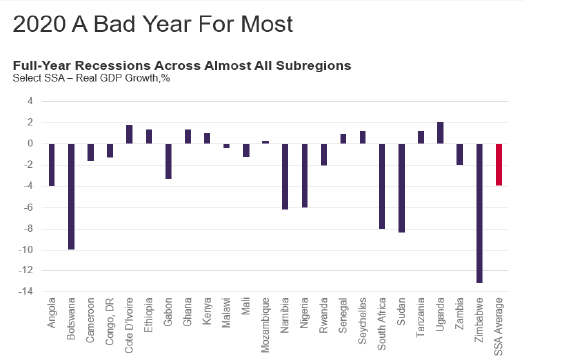
“2020 has been a very challenging year for sub-Saharan Africa. Fitch Solutions expects full-year recessions in many major markets and forecasts sub-Saharan African GDP to shrink by around 3.9%.“
– Jane Morley, Head SSA Country Risk, Fitch Solutions
Sub-Saharan Africa’s (SSA) Markets hit by a range of external and domestic factors
A sharp slowdown in global and Chinese growth in the first half of 2020 has depressed commodity prices, including oil and minerals which dominate SSA’s export markets.
International travel restrictions have led to slowdowns and redundancies in tourism and related consumer-facing industries.
Broad risk-off sentiment has led to depreciating pressures on free-floating currencies, fueling inflationary pressure, and constraining consumer demand.
Imposed lockdowns of varying stringency are acting as a constraint on consumer demand and business investment.
Positive signs for Q2 2020 and beyond
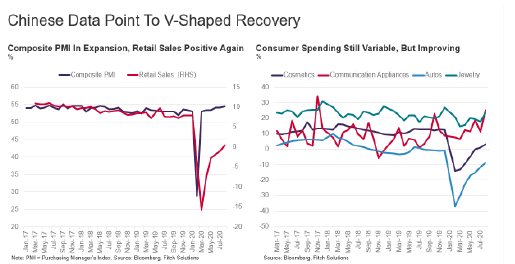
From an African perspective, Fitch Solutions expects China to see a V-shaped recovery after a record low performance in Q1 2020.
Q2 2020 will be the low point of growth for most African countries as national lockdowns are lifted.
GDP is estimated to expand by an average of 4.2% in August and 5.8% in 2021.
If COVID-19 vaccines can be rolled out in Q1 2021, we can expect positive effects on African markets and exports in the second half of 2021.
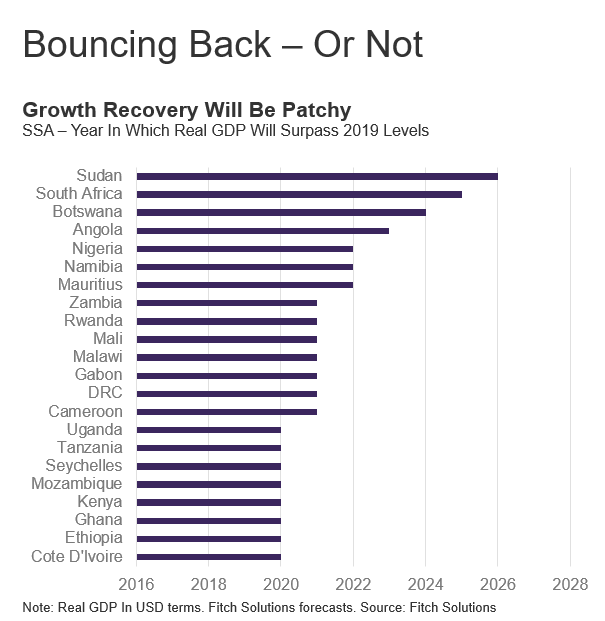
Growth and recovery will be patchy
SSA markets are expected to experience a multi-speed recovery. The specific timing of when individual SSA markets return to 2019 level of economic output will depend on the severity of the downturn.
Round-up of the webinar discussion –
How do we reduce risk and increase capital in African markets in the wake of COVID-19?
The tools for recovery in Africa are not the same as in more developed areas. Most African countries were already under fiscal pressure before the crisis started, and the ability of their governments to spend their way back to financial health is constrained. Interventions from central banks, governments, and IMF have provided stability in the short-term, however, long-term solutions are needed.
Improving access to capital
Banks are one of the primary ways to mitigate the shock of COVID-19. They are extending moratoriums on funding and providing new access to money for SME’s.
Banks need to look at ways to unlock local liquidity through asset purchase programs and guarantees on loan portfolios.
The international community needs to target African banks and support them to unlock liquidity to help people recover from the economic shock of COVID-19.
Beyond COVID-19 what needs to happen to ensure African market resilience and structural investor interest in the future?
Gaining investor trust and confidence back to invest in African countries
Setting up financial infrastructure that underpins capital market resilience to be ready for future shocks
Promoting legal and regulatory reforms
Participants key take-aways:
Philip Buyskes, CEO of Frontclear
“Given the limited fiscal space of many sovereigns in Africa and the limited monetary policy tools available, the role of the financial sector in supporting the recovery is perhaps more important than in any other region. Whilst the banking sector has entered the crisis on good footing support from the international community will be key in the coming months.”
Arnold Bagubwagye, Deputy Director, Financial Markets Department at the Bank of Uganda
“The future is bright. We are building a conducive environment to attract capital into Uganda and the East African region. We are signing final oil and gas investment decisions and expect large flows of capital coming into the region in the second half of next year. In partnership with Frontclear, we will address all loopholes and stumbling blocks to prepare our market for a bright future.”
Ruurd Brouwer, CEO of TCX
“It really is about developing markets and financial innovation. This is the fourth global crisis in the last 12 years and there will be more. The challenge is to make African markets resilient and developed so they can handle these crises.“
Joost Zuidberg, CEO, Cardano Development
“Difficult times can lead to useful innovation. We are hoping the parties in the market use this time to push through required reforms and better prepare themselves for the future. Let’s work together to make these innovations happen.”
Alexandre Visentin, Sovereign Sector, Global Markets, Societe Generale
“Our process to grow our fixed income business in Africa is gradual and incremental. We appreciate the pragmatism of our partners Frontclear and TCX. We need to go back to Nigeria and consolidate our business there.”
Listen to the full webinar below and follow our #CDInsights for future information :